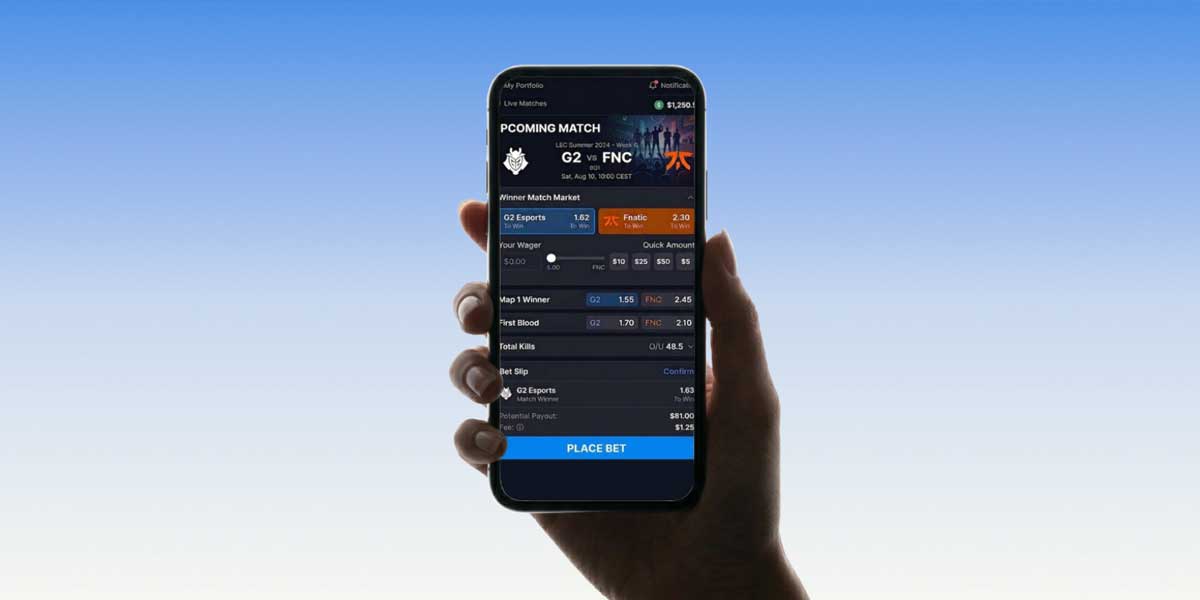
More than 1.7 million League of Legends fans made predictions on Riot’s Crystal Ball during MSI 2026, and not one of them wagered a cent — they just wanted the small, addictive dignity of having called it. One click to the left, that same appetite is a $10.7 billion betting market, and over the past year nearly every institution in esports — publishers, data providers, teams, prediction markets — has reached for it at once, for reasons that are individually defensible and collectively unexamined.
Somewhere in late June, a League of Legends fan sat down to watch a Play-In match between two teams he had no feelings about whatsoever. His own team was out. Under any normal circumstance he would have checked the result later, if at all.
Instead he watched every game. He tracked statistics. He argued with friends about champion picks. He was, by his own account, more invested in the tournament than he had ever been — because he had made a set of predictions on Riot’s Crystal Ball, and the jackpot was every ultimate skin in the game.
He was one of more than 1.7 million people who engaged with Crystal Ball and Pick’Ems during MSI 2026, according to figures released by Riot and its data partner GRID. It was the first tournament where Riot used GRID’s official live esports feed to power the prediction game. Not one of those 1.7 million people put up any money.
That is worth sitting with, because it is the cleanest evidence anyone has produced about what fans actually want here. The appetite is not for risk. The appetite is for *having called it* — for the small, addictive dignity of watching a match you have staked an opinion on. Riot manufactured that feeling with emotes, icons, and a skin, and 1.7 million people showed up for it.
The complication is that the same appetite, one click to the left, is one of the fastest-growing businesses in gaming. And in the last twelve months, nearly every institution in esports has reached for it at once — for reasons that are individually defensible and collectively unexamined.
Ten point seven billion dollars, mostly in the dark
In June 2025, Riot’s esports president John Needham published a post that had been years in the making. The company was opening the betting sponsorship category to Tier 1 League of Legends and VALORANT teams across the Americas and EMEA, reversing a long-standing prohibition that teams had spent years asking him to reconsider.
His numbers did the arguing. Sportradar put global betting turnover on League of Legends esports and VCT alone at $10.7 billion in 2024. Roughly 70% of sports bets worldwide are placed with unlicensed bookmakers. That activity exists whether or not Riot acknowledges it; abstaining doesn’t shrink the market, it just means the sport has no visibility into it and no leverage over the operators running it.
So Riot built a fence and stepped through. Every betting partner has to be vetted and approved before a team can sign one. Approved operators must use GRID’s official data. Teams must stand up an internal integrity program covering policy, monitoring, and education. Riot’s own broadcasts and social channels stay clean — no ads, no sponsored segments, no operator logos on jerseys. And a slice of Riot’s revenue from the program is routed to Tier 2: bigger prize pools, new tournaments, integrity systems, education for players who haven’t made it yet.
Showing up responsibly, as Needham framed it, is “better than letting others define it for us.”
It is, by some distance, the most carefully constructed entry into this category that any gaming company has made. It is also where three separate decisions quietly became one: prediction as a fan mechanic, official data as integrity infrastructure, and wagering revenue as a line on a team’s balance sheet. All three now travel under the same sentence — *the betting is happening anyway* — and only one of them has been tested against the alternative.
The data pipe runs both ways
Riot took its stake in GRID in 2023 with a specific theory of the case: a single trusted, low-latency official data source would undercut the grey-market suppliers and make the sport harder to exploit. Clean data as a weapon against dirty money.
In June 2026, GRID signed a partnership with Polymarket — supplying the prediction market with official low-latency data and integrated live streams inside its trading interface. Kalshi has been building out its esports offering in parallel; June figures showed Counter-Strike 2 leading its esports volume, League of Legends second.
Nobody did anything wrong. But the infrastructure built to starve the black market is now the growth substrate for platforms currently fighting a fifty-state legal war over whether they constitute gambling at all. Making a sport legible to operators makes it safer *and* makes it easier to build more products on. The clean-data solution turns out to also be a distribution deal.
The player who kept walking into fire
The reason any of this carries more weight in esports than in football comes down to how the games themselves are built.
In October 2025, at ESL Pro League Season 22, a Counter-Strike 2 player kept dying to incendiary grenades. Not once — repeatedly, in ways that read less like misjudgment than like a man stepping deliberately into a burning doorway. Analysts pulled the footage. Each incident lined up with a spike in wagering on the specific in-game outcome market that covered it, activity traced to dormant and high-value accounts.
Dmytro “nifee” Tediashvili was banned for four years. The Esports Integrity Commission used the case to say what the industry had been slow to: that proposition markets carry “acute integrity risk due to their susceptibility to manipulation”.
Consider the asymmetry. Fixing a football match takes a conspiracy — several players, coordinated across ninety minutes, under cameras. Fixing a Counter-Strike prop takes one player walking into a fire once. And the settlement is automatic, because the game engine logs everything: every death, every round margin, every objective, timestamped and machine-readable. Traditional sport had to invent prop markets and then build the apparatus to settle them. Esports emits them.
The bill is already arriving. ESIC issued 14 disciplinary actions in April 2026 alone, most for match manipulation tied to betting. Its investigation into the Mongolian team ATOX turned up more than 70 suspicious bets, betting accounts sharing device IDs and payment instruments with team personnel, chat logs and call recordings, and an analyst who fed his own team deliberately misleading in-game instructions — “an entrenched practice embedded in ATOX’s competitive calendar”, with money traced to organized crime.
This month in Paris, at the Esports World Cup, the Dota 2 roster PlayTime flew in, made it as far as the venue, and never played. Integrity suspensions of its mid laner and coach left the team without an eligible lineup, and it was disqualified before the tournament properly began.
The pattern in the caseload is not the marquee events. It is the tier below — the leagues where prize money is thin, salaries are thinner, oversight is minimal, and betting volume has quietly become substantial. A player earning a few hundred dollars a month is being offered more than that to die to a grenade. Riot’s Tier 2 reinvestment is aimed at exactly that gap; whether money arrives faster than the offer does is not yet knowable.
Gambling that only asks for a Steam login
There is a demographic underneath all of this that traditional sport has never had to reckon with in the same way.
Most US states set the legal gambling age at 21. Prediction markets let 18-year-olds trade. The fastest-growing channel in the category has the lowest floor — and it sits beside an audience that has been handling tradable, cashable digital objects since childhood.
A survey of 1,530 US gamers run by TrustPlay in late 2025 found that among the 918 who owned tradable skins, 47.1% had gambled with them, 43.5% had started before they were of age, and 76.1% of parents had no idea. It is a self-selected vendor survey and deserves to be read that way — but it points where the independent research points. A UK Gambling Commission study found 27% of players aged 16 to 18 had engaged in skin betting. Peer-reviewed work in *PLoS ONE* documented esports betting, in cash and in skins, among Australians aged 12 to 17. New Canadian research this month links loot box purchasing to gambling problems, mental health difficulties, and compulsive behavior.
The mechanism is specific to gaming and depressingly simple. A sportsbook requires a card and identity verification. A skin site requires a Steam account, which millions of teenagers already have. The rail was built into the product a decade before anyone thought to regulate it.
Faker puts on a badge
In Seoul, the most decorated player in the history of the sport put on an honorary badge from the Korean National Police.
Faker — six world championships, a skin line in which Riot’s artists hand-animated his celebrations — said he intends to take part in ambassador work including “widely publicizing to teenagers the dangers of online gambling”. Korean police have been shutting down gaming cafés that let minors bet on esports. Gambling is tightly restricted in South Korea, and estimates put the illegal market above $80 billion, a number in which esports is not a rounding error.
It is a strange tableau if you line it up: the player whose championship generates a skin collection that routes thirty percent of its revenue back to his team, standing in a police station, telling teenagers to stay away from the thing his sport is currently deciding how much of to sell.
He may simply be drawing a line the rest of the ecosystem hasn’t gotten around to drawing yet — between selling a fan a memory and selling a fan a position.
The law changes at the state line
Meanwhile the legal ground keeps moving under everyone’s feet.
Washington issued a preliminary injunction against Kalshi this July and could enforce a ban within weeks, joining Nevada and Michigan. Minnesota criminalized the operation, hosting, and advertising of prediction markets outright in May. Arizona filed criminal charges — the first against a CFTC registrant. The CFTC has sued states to defend what it calls “unprecedented overreach by some States”. In April the Third Circuit held that sports event contracts are federally regulated swaps beyond state reach; a Massachusetts court had already dismissed that same theory as “overly broad”.
Whether a fan holding a position on a T1 series is a gambler or a derivatives trader currently depends on which state line he is standing behind, and on appellate arguments that have not reached the Supreme Court.
Everyone who wants his next click
None of which the man watching that Play-In match in June had any reason to think about.
He had made his picks. He had no money on it. He watched a game between two teams he didn’t care about and found, to his own surprise, that he cared — and he would very much like to win every ultimate skin in the game.
There are now a considerable number of institutions interested in what he does next: a publisher that can sell him a jackpot for free, a data company that supplies both the integrity monitors and the trading floor, teams looking at a new sponsorship category to cover payroll, prediction markets that would like him to hold a position rather than an opinion, and a police force in Seoul that would rather he did not.
The distance between where he is now and where all of them would like him to be is about one click. Nobody in esports has yet said out loud how much of that distance they intend to close.