There are three billion gamers on the planet. Most of them just want to play. The rest of the internet, unfortunately, has other ideas. Harassment. Scams engineered to drain children’s virtual savings. Predators hiding behind voice changers to sound like teenagers. And now, AI-powered schemes that spend weeks profiling individual players before moving in for the kill. The threats facing online gaming aren’t new — but they’re getting smarter, faster, and harder to see coming.
At a recent Esports Trade Association panel on trust and safety, two founders made the case that the solution isn’t just better moderation. It’s building systems that understand players as deeply as the bad actors do.
The Attack Vector Is Trust
Ron Kerbs has watched the scam playbook evolve in real time. His company, Kidas, monitors voice and text communications across more than 2,000 games — nearly one million players, over 100 million conversations analyzed to date.
What he’s seeing now is more calculated than a stranger shouting slurs in a lobby. Today’s threat is patient. “They know exactly what you’re playing, with whom, what time you’re playing,” Kerbs said. “All of those things — very personalized.” AI agents join games, gather intelligence, and hand it off to scammers who arrive already knowing their target.
The most damaging schemes take months. A player befriends a child, builds rapport, earns trust — then proposes a simple account swap to “help” with something. The child agrees. Their years of accumulated virtual assets vanish. So does their desire to ever log on again.
“Those players are lost players,” Kerbs said flatly. “They’re not going to come back.”
Kidas fights this by building longitudinal profiles — not just flagging a single message, but tracking behavioral patterns over time and calibrating alerts to a player’s age. What’s a red flag for a twelve-year-old won’t trigger the same response for a seventeen-year-old. Context, Kerbs argues, is everything.
Coaching and Catching Cheaters Are the Same Problem
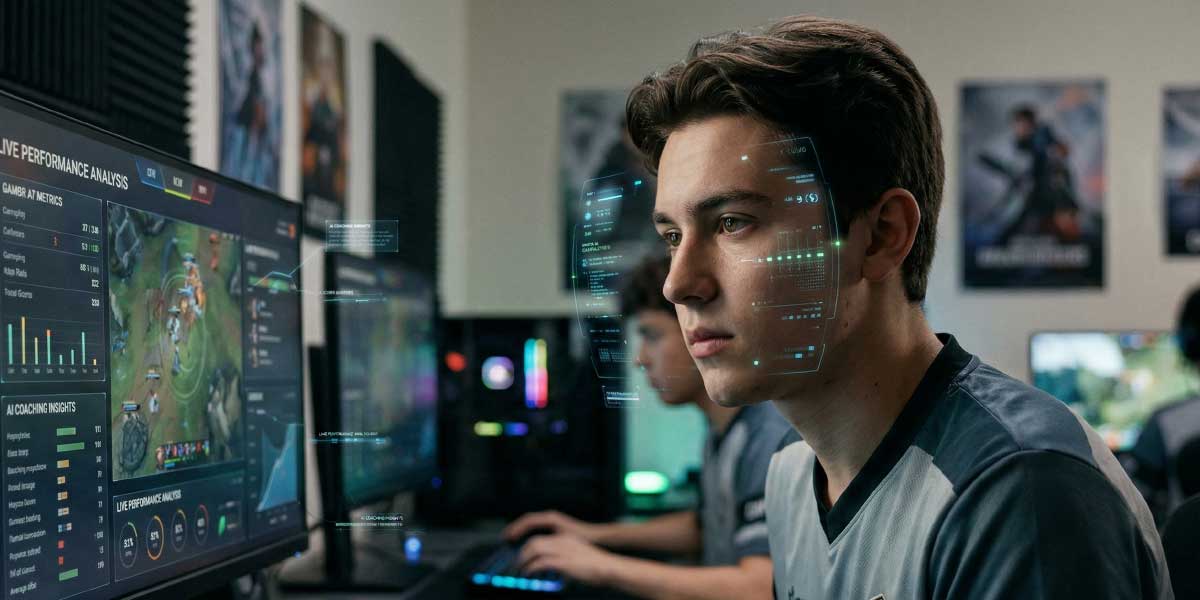
Shubber Ali came at this from a completely different direction. Omnic.AI started as a coaching tool — computer vision that watches gameplay frame by frame and tells you what you’re doing wrong. Wrong weapon, wrong rotation, wrong call. Over 40 universities and high schools now use it. Forty thousand users and growing.
But the same fingerprinting that makes a coaching platform useful turned out to have a second application: catching cheaters.
“If somebody plays wildly differently than the way they played before and did much better,” Ali said, “that should generate a red flag.” The platform can detect when a player’s style shifts so dramatically mid-tournament that someone else has clearly taken over — a growing concern as prize pools climb and betting markets expand around collegiate and international competition.
Ali is also working on something he describes as Tinder for team-building — matching players not just on skill level, but on temperament and behavior. His rough framing: a scale where a ten “plays like Mister Rogers” and a one “would embarrass sailors on a ship at sea.”
The vision is a lobby where you actually know who you’re getting.
Governance Can’t Wait for a Crisis
The conversation turned darker — and more interesting — when moderator Dr. Demetrios Roubos asked what schools, leagues, and orgs should actually be doing differently in the next two years.
One gaming company, Kerbs recalled, once floated the idea of quarantining toxic players into their own servers — then populating those servers with bots programmed to be toxic right back. “It sounds like something from Black Mirror,” he said. A social score for gamers. Behavior logged, calibrated, consequenced.
Both founders agreed the real answer is earlier and less dramatic: codes of conduct before competition begins, emotional regulation coached as seriously as in-game mechanics. “When you’re being toxic, you’re being less productive with your team,” Kerbs said. “It affects your performance.” Safety and performance, it turns out, pull in the same direction.
Ali pointed to scouts as his model — kids who sign a code of conduct when they join a troop, creating accountability before anything goes wrong. The equivalent in esports barely exists at scale yet. It should.
Most Players Just Want to Play
Kerbs closed the panel with an important correction to everything he’d just said. Most gamers, he reminded the audience, aren’t doing any of this. They’re not scammers. They’re not cheaters. They’re just people who love a game.
Ali agreed. “Go enjoy it. Why do you play games? Have fun.”
Three billion people are counting on someone making that possible. A few of them are finally building the tools to do it.