Every employer says it can’t reach young talent. Esports fans — three-quarters of them under 30 — show up by the hundreds of thousands, every season, on a published schedule. One logistics giant turned that crowd into 50,000 job applications, and not just for coders. Here’s how eight years of showing up for the community became the most productive hiring channel in esports.
Before a single match is played at an ESL FACEIT Group tournament, a logistics operation has already run in reverse. Hundreds of tons of staging. More than 3,500 square metres of LED screen. Gaming chairs, trussing, broadcast kit, merchandise — all of it trucked into an arena, built, lit, and then torn down again for the next city on the circuit. DHL has moved that freight since 2018, when the partnership launched in Birmingham, England. For the first few seasons, the yellow-and-red logo on the stage was simply what a shipping contract looked like from the cheap seats.
Somewhere between Birmingham and now, the trucks stopped being the point.
Today, DHL runs the most thoroughly documented recruiting operation in esports: a channel that has drawn one million visits to its careers pages, 400,000 job views and 50,000 applications, according to figures the company provided to EsportsNext this month. Those numbers are five times what DHL last published, in 2024. And when the company was asked what kind of workers those 50,000 applicants were, it gave an answer that should change how every employer in this industry looks at the crowd in the stands.
They weren’t just the coders everyone expected. They were drivers. Warehouse employees. Students. The exact people a global logistics company needs by the tens of thousands, and the exact people a global logistics company has the hardest time reaching.
The Unreachables
DHL has a word for the people it is trying to hire. It calls them “the unreachables.”
On paper, the company should have no trouble attracting anyone. It operates in more than 220 countries and territories, and nearly everyone on earth knows the name. But that recognition cuts the wrong way. People know DHL ships parcels. They picture a van, a uniform, a doorstep. What they don’t picture — what DHL has written that even many young professionals fail to realize — is the sprawl of careers behind the brand: warehouse automation, data platforms, customer-facing frontline roles, back-office operations, high-tech engineering. The company’s visibility problem isn’t that people haven’t heard of it. It’s that they think they already know everything about it.
Layer onto that the audience it needs. The digital-native generations are the first to grow up in a globally connected world, and they are also the first to have learned, from infancy, to ignore everything a brand tries to tell them. They don’t watch television. They skip the pre-roll. They have an instinct for the difference between a company that belongs in their space and one that bought its way in.
“EFG offers a different kind of sponsorship than traditional sports,” says Dirk Behrend-Uçak, senior sponsorship manager in DHL Group’s brand marketing division. “You reach a target group that is not easy to reach via traditional channels, like TV. You catch them where they are, in their environment, and where they play. But you have to do it authentically.”
The math of where they are is simple. More than 75 percent of EFG’s fans are between 16 and 29 — a figure DHL confirmed for this article. That is the demographic every employer staring at a retirement curve says it cannot find. It is sitting in the arena, by the thousands, and it has already bought a ticket. The question was never whether the audience existed. It was whether a shipping company could earn the right to talk to it.
Four Years of Jokes Before a Single Job Listing
DHL’s first move was not a careers page. It was a comedy series — and the choice says everything about how the company read the room.
A logistics brand arriving in a gaming community in 2018 could have done what sponsors had always done: buy space around the broadcast and be tolerated. DHL did something else. It made something the audience would choose to watch, and it made it with a person the audience already trusted. SirActionSlacks is a Dota 2 personality known for entertaining videos in that game’s community — a “legend,” in DHL’s own description — and in him the company found what it calls “an authentic, human face” for the brand. Rather than placing its logo beside the content, DHL put itself inside it; the company describes itself as the first brand to build a meaningful connection with esports by creating content that integrates seamlessly into the esports world.
The result was DHL Dota Adventures, a collection of Dota 2-related episodes starring Slacks and a sidekick the company already had on the payroll. EffiBOT is a real DHL warehouse robot, built to follow employees through facilities and carry heavy loads. In the series, the robot became a character in its own right — the deadpan partner to a comedian, a real piece of DHL warehouse equipment turned into a recurring joke. The pairing worked. The series quickly became the most enjoyed content at ESL tournaments, and fans came to expect DHL red and yellow at the events the way they expected the teams. “Together with Slacks, we speak directly to esports fans,” the company has written, “opening their eyes to the world of logistics and the many career paths we offer that are ideal for gamers.”
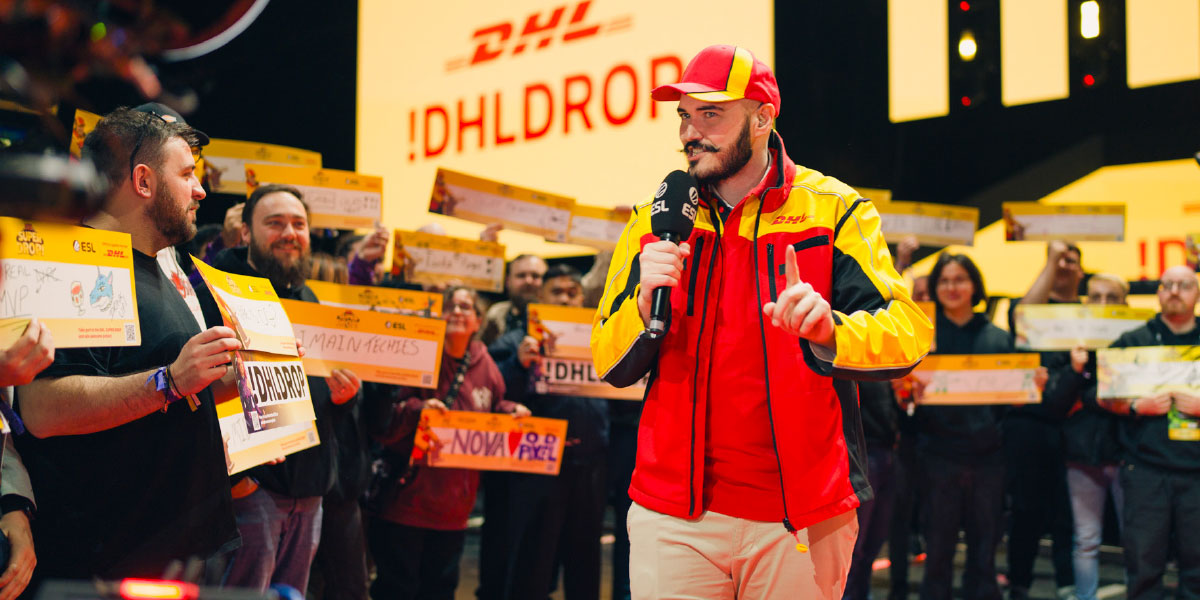
The company kept finding ways to let fans participate rather than watch. At live events, DHL Drop awarded prizes to fans who showed up with the most original messages on a DHL poster. Viewers at home could enter the same contest by typing “!DHLDROP” into the Twitch chat — a sponsorship mechanic that lives inside the stream rather than interrupting it. A virtual-reality game, DHL Box Stacker Pro, let fans try their hand at loading freight. EffiBOT Dash, a mobile jump-and-run, let them drive the robot and collect parcels on their phones, with an EffiBOT World Championship offering prizes. Each activation was a small, playful invitation to spend time with a logistics brand, and none of them asked for anything in return.
The Funnel That Grew Five Times and Kept Its Shape
Asked to update those figures for this article, a DHL Group spokesperson provided three new ones: one million visits, 400,000 job views, 50,000 applications. Cumulative, and five times the 2024 totals across the board.
Growth is one thing. What is remarkable is what stayed the same underneath it. Work the proportions and roughly two in five visitors still click through to a job listing, and about one in twenty still submits an application — ratios that appear broadly unchanged from 2024, when the funnel was a fifth of the size. Recruiting channels normally degrade as they scale. You buy more reach, the new reach is less interested, and conversion sags. This one held its shape through a five-fold expansion.
That is the difference between a campaign and a channel. A campaign spikes and fades. A channel keeps its proportions while it grows, which is how infrastructure behaves. The figures are round and the ratios are approximate, but the pattern is unmistakable: the more fans DHL reached, the more of them wanted to work there.
Then comes the part that turns a DHL story into an industry story. The reason most employers dismiss esports recruiting is that they assume it reaches young technologists and nobody else — useful if you’re hiring developers, irrelevant to the frontline roles where logistics, manufacturing, retail and healthcare are actually short. DHL’s own 2022 launch was built on the same assumption. Asked this month which roles those 50,000 applications actually targeted, the spokesperson’s answer was broader than anything the company had said before.
The audience that was supposed to be a niche turned out to be a cross-section of the entire workforce DHL needs. And those applicants are not a lower grade of candidate. “Candidate quality is on par with non-sponsorship based recruiting efforts,” the spokesperson said, “validated by our inhouse talent scouting team.” Parity sounds modest until you set it beside the volume. Five times the applications arrived, and the average didn’t move.
Earn the Room, Then Make The Ask
Ask DHL what made it work and the company doesn’t point to the careers page, the comedian or the robot. It points to the order they came in.
“We invested in the esports community long before using it as a recruitment platform,” the spokesperson said. “That credibility and long-term commitment are essential. Without delivering genuine value to the community, an esports activation risks being seen as just another sponsorship or media buy.”
Four years of comedy videos, robot cameos and poster contests came before the first job listing. By the time DHL asked the audience for something, the audience already liked it. That sequence — earn the room, then make the ask — is the whole method, and it is why fans met a logistics company’s job board with curiosity instead of eye-rolls. It is also the part that cannot be compressed. Credibility in this community is measured in seasons, not quarters.
The second principle is to make the pitch about the fan, not the employer. DHL’s Ultimate 10 activation, built around its Counter-Strike presence, connects the skills the game rewards to the skills its jobs require, and lets players discover with a click which DHL roles match their own. “The intent of the Ultimate 10 campaign was showing skills sharpened through gaming, like fast decisions under pressure and teamwork, carry into working life,” the spokesperson said. DHL wasn’t screening gamers. It was telling them their hobby is evidence of something an employer wants — a message that lands very differently from a job description, and one a 22-year-old Counter-Strike player had probably never heard from a global logistics company before.
The third is to measure what actually changes, not just what gets clicked. DHL tracks its funnel through to applications by channel. It also runs the kind of research most sponsorships never bother with. “We also measure the impact on brand perception,” the spokesperson said. “Through pre- and post-campaign studies, including implicit association testing, we have seen measurable shifts in how fans perceive DHL.” That is the detail that separates this program from a logo with a careers URL attached: the company can tell the difference between fans who noticed it and fans who think differently about it. Its verdict on the whole approach is unambiguous. “Interest-based campaigns perform better than classic employer branding / recruiting campaigns.”
The Audience Keeps Showing Up. So Does DHL
This is no longer an experiment. “In 2026, we are live with three campaigns — Counter-Strike, Dota 2, Overwatch — promoting jobs in 21 hub regions across 9 countries,” the spokesperson said. The program that started as a Dota 2 comedy series now spans three titles, and the sponsorship that began as a freight contract is a multi-region hiring channel with a roster that runs from the warehouse floor to the IT department.
“Gaming is only getting bigger and more competitive,” says Shane Clarke, EFG’s director of game ecosystems for Dota 2. “The natural growth of esports is going to continue.”
So will the crowd. The same fans fill the same arenas and the same streams every season, on a schedule published months in advance — young, global, and more than willing to listen to a brand that has earned the right to speak. DHL spent eight years learning the language. The return is a million visits, fifty thousand raised hands, and a recruiting pipeline that gets stronger every time the lights go up.
The workforce was always in the arena. DHL just showed up first.