When a top Rocket League player sat down at his signing day table to accept a collegiate esports scholarship, it represented more than a tournament win. It marked the moment a high school passion turned into a tangible postsecondary opportunity. Last year, that same high school program celebrated another milestone: a standout Super Smash Bros. player earned a collegiate scholarship to study game design.
These individual achievements point to possibilities beyond competition when scholastic esports grows from an after-school gaming club into a formal Career and Technical Education (CTE) pathway. Before the four-year academy took shape, Jupiter Community High School already had an after-school club, digital classes, access to games, and capable computers. The next step was a coherent pathway connecting those strengths. Turning enthusiasm and equipment into teachable, assessable student work is the real job of an esports CTE program, and it depends on the educators who run it.
That translation is not a new problem. In 2004, a U.S. Senate committee report on CTE placed responsibility for keeping programs aligned with industry practices on teachers, administrators, and counselors. Two decades later, Florida’s 2025–26 CTE frameworks added a middle school course in the fundamentals of artificial intelligence. The tools keep changing. The question does not: how do we help educators turn changing work into learning students can actually do?[1][2][3]
Esports makes that question unusually visible, because student enthusiasm tends to arrive well before the instructional plan does. The same pattern shows up in pathways such as Hospitality and Tourism or Television Production: every CTE blueprint must specify student work, transferable skills, evidence of learning, and support for teachers after launch.
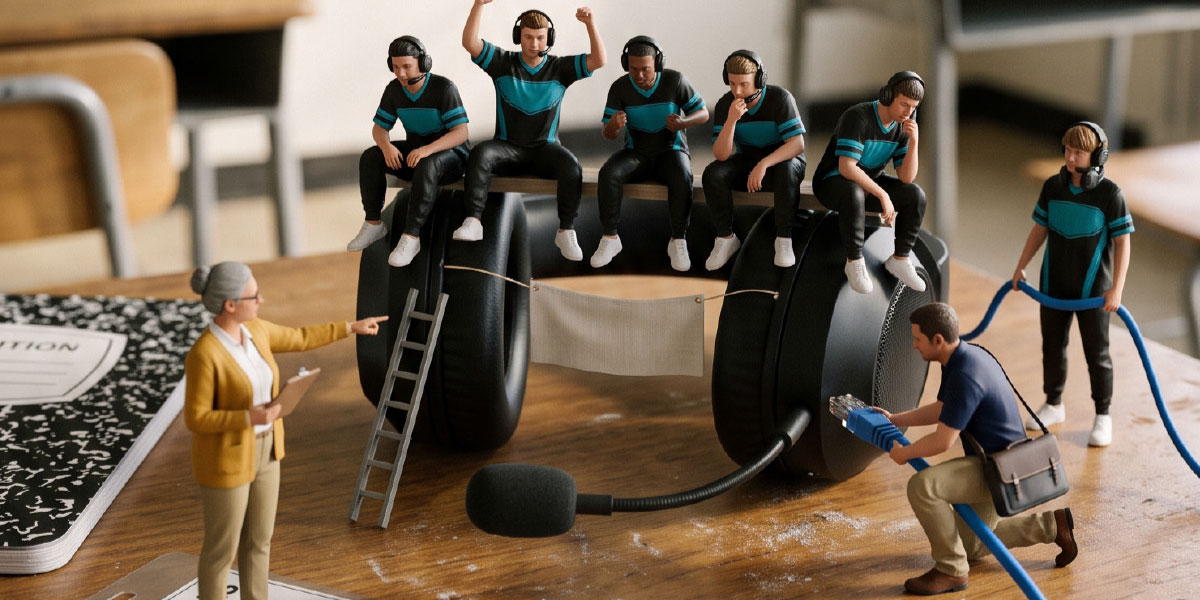
The answer is larger than a training day. A teacher may leave a workshop excited about a streaming tool, then return to limited planning time, a locked-down school network, and aging equipment. A program document may identify standards and credentials while leaving the daily instruction to the teacher. That space between a sound plan and a working classroom is the implementation gap, and it is where an esports pathway succeeds or stalls.
More Than a Roster: Where Esports Meets the Workforce
The skills inside a well-run esports program map to occupations the U.S. Bureau of Labor Statistics (BLS) already tracks:
Broadcasting & Live Production: Broadcasting a match draws on the work of broadcast, sound, and video technicians, who earned a median of $60,150 in May 2025, and film and video editors, at $75,420.[6][7]
Event Operations: Running a tournament resembles the work of meeting, convention, and event planners ($61,160), a field BLS projects to grow 6 percent from 2025 to 2035, faster than average.[8]
Lab Management & IT: Keeping a gaming lab online draws on network and computer systems administration ($99,130).[9]
Branding & Digital Media: Building a team’s visual identity draws on graphic design ($62,960).[10]
Not all of these fields are growing uniformly: BLS projects employment for network administrators to decline 4 percent and for graphic designers 2 percent over the same decade. Its separate analysis of AI and technology occupations makes the same point: career courses need regular attention to how work is changing.[4][9][10]
Schools cannot rebuild a course every time a game patch, streaming platform, or AI tool changes. They can, however, give educators a repeatable way to ask whether an industry change affects what students should know, make, or explain. Consider a match highlight package. Editing software and AI workflows will change. Students still need to interpret a brief, identify an audience, make choices about accuracy and rights, revise, and explain the result.
Inside the Jupiter Build
Jupiter’s academy was designed as a four-year information technology CTE pathway that connected competition to production, audience communication, events, media, and technical problem-solving, giving teachers work they could observe and assess.
The design started from what students should know and produce, then worked backward to courses, teacher support, and technology. Through collaboration with administrators, the CTE chair, the school’s media specialist, and IT staff, the vision for the academy became a concrete program outline that connected the existing club, digital classes, and equipment into a coherent four-year CTE pathway. That sequence is the first lesson for any school: inventory what already exists, then connect it through student work before buying anything new.
The student work mirrored the industry around the game. Students wrote essays analyzing a game character’s strengths and weaknesses, practicing the same make-and-defend-a-judgment work an analyst or coach does in match review. In groups, they led school competition events and took on event planning, production, promotion, and technical support: the core of tournament operations. They also completed projects on broader industry topics, producing work teachers could assess beyond wins and losses.
Jupiter’s esports program benefited from Full Sail University’s TechFest visit, which gave students hands-on opportunities to explore esports, game design, and emerging technology. Partnerships with local organizations and colleges helped students see possibilities beyond high school. The Rocket League and Super Smash Bros. scholarships were individual milestones that illustrated two possible routes beyond competition.
Who Coaches the Coach?
Now consider what a teacher must know to make those assignments possible. The teacher does not need to be the best player in the room. Someone must connect the writing, event, or industry project to course standards; set clear expectations; guide students with very different levels of game and technical experience; and assess individual contributions to a team result.
For a production activity, the teacher must also understand the streaming, capture, and editing tools available at the school. If a program adds new responsibilities without preparation time or technical support, its ambitions can quickly outrun its capacity.
Credentials Worth the Grind
Industry certifications can help a pathway give students a recognizable goal and help schools describe a technical skill set. They can also inform a teacher’s planning: What must students practice before an assessment? Which performance tasks show that they understand the underlying work? Where does the certification align with course standards and the needs of employers or postsecondary programs?
Students in the Jupiter program earned Adobe certifications. A credential belongs in a pathway when its skills fit the educational purpose, the school can provide meaningful practice, and students can use what they learn in authentic work. If students memorize application menus solely to pass an exam, the course misses the larger skill.
In an esports pathway, the credential should show up in something students made: a video editing credential alongside a produced match highlight reel, or a design credential alongside a team branding kit. The credential should fit local goals and requirements.
Teachers need time to learn the workflow, examine student work, and adapt assignments to their equipment and students. Students also built portfolios they could take with them, showing what they made beyond the exam. Certification results are useful, but leaders should examine that work as well.
Closing the Gap: Start With the Work, Not the Hardware
A Government Accountability Office review of selected CTE providers and states documented several practical constraints: difficulty obtaining current technology, challenges recruiting and retaining teachers with technical expertise, and a need to help industry professionals develop teaching skills. An esports pathway can run into all three at once. [5]
An implementation discussion should begin with the work students will do. Suppose a school wants an esports pathway because student interest is high. The first question is not which game or equipment package to buy. It is what students will learn and how they will show it:
Digital Media: Identify a production task and the standards it addresses.
Business: Define the audience, budget, schedule, or service problem students will manage.
Data Literacy: Decide what students can responsibly collect, analyze, and explain.
A pathway may include competition, but a roster alone does not demonstrate those other skills.
Next, examine what the educator must be ready to teach. Can the teacher model the task? Is there a sample deliverable and an assessment rubric? Does the teacher know which parts require direct instruction and which students can learn through guided practice? What will happen when a game update breaks the broadcast setup or a PC fails mid-match? These are ordinary classroom questions, yet they often receive less attention than the public launch of a new program.
A practical professional learning cycle has three phases. First, teachers examine an emerging workflow, such as producing a live match stream or using AI tools to promote a tournament, and identify the standards and student work it could support. Second, they complete a small version of the task themselves and adapt it to their school’s tools and students. Third, they teach the task, examine student work with a colleague, and revise it. That gives teachers practice and feedback beyond a single workshop.
An industry partner can contribute without carrying the program’s teaching load. Production staff from a collegiate esports program, a regional esports venue, or a local media professional might review a one-page project brief for current terminology and tasks, then give limited feedback on a sample of student work against a teacher-provided rubric. Schedule those reviews in advance. The teacher retains curriculum, assessment, and grading decisions; the school keeps the assignment and rubric usable if a partner cannot return.
Your Network Admin Is on the Team
School leaders also have a role. At Jupiter, a device could fail to register or a link needed for instruction could be blocked by district controls. Student safety and district rules came first, so staying in contact with the IT department was part of making the pathway teachable.
Before approving purchases, ask:
- Who will approve access, game clients,
and accounts? - Which titles fit the school’s age-rating and content policies?
- Who will renew software and
league licenses? - Who will maintain equipment and troubleshoot during class?
Protect teacher planning time, document the lessons, and share responsibility so the pathway can continue when personnel change.
The Scoreboard Isn’t the Report Card
Claims about workforce readiness deserve evidence. Schools can begin with measures they can collect:
- Track whether teachers complete preparation and can run the planned assignments.
- Examine student artifacts against the same criteria over time.
- Record credential attempts and attainment along with the opportunity students had to prepare.
- Look at participation in broadcast, event, business, and technical roles as well as competition.
- Ask students to explain the occupation or transferable skill connected to their work.
Schools should distinguish activity from progress. A winning season or a well-attended tournament demonstrates interest and organization. A student’s portfolio, completed project, and explanation of decisions show different learning. An Adobe certification result provides another kind of evidence, though it needs context about access and preparation. Together, these measures help educators see what is working and what to improve.
The same principle applies to professional development. Attendance documents a session; revised lessons, student work, and improved delivery show the support reached the classroom.
Game Plan: Six Moves for School Leaders
Each lesson in this article points to the same place: an esports pathway succeeds or stalls in the gap between the plan and the classroom. Jupiter’s academy took shape by connecting what already existed through student work, keeping IT close, and measuring more than wins. For administrators and CTE directors weighing a program this year, six moves can close that gap before launch day:
- Define the student work first. Name the production, event, business, or data task and the standards it addresses before
any purchase. - Let teachers rehearse. Give them time to complete a small version of each task on the school’s own equipment before teaching it.
- Bring IT in early. Settle network access, game clients, student accounts, and licenses before launch day.
- Use partners as reviewers, not instructors. Schedule their feedback against a rubric the teacher owns.
- Measure the work, not the win-loss record. Track artifacts, credentials with context, and participation across roles.
- Document for continuity. Write down what works so the pathway outlasts any
one educator.
None of these moves requires a bigger equipment budget. Each one asks leaders to plan for the people who will teach the pathway, not just the hardware they will teach it on.
The People Who Keep Pathways Current
CTE educators must interpret standards and industry practice, choose technology, and turn it into manageable lessons. New tools can widen the possibilities of a course, but they also increase the need for sound instructional judgment.
A blueprint earns its value in use. The best question for a school is not whether the esports program looks current on launch day. It is whether teachers have the support to keep its student work relevant, rigorous, and teachable as the field changes. When educators can do that, students have a better chance to move from the player’s chair to the producer’s desk, and from interest to demonstrated capability.