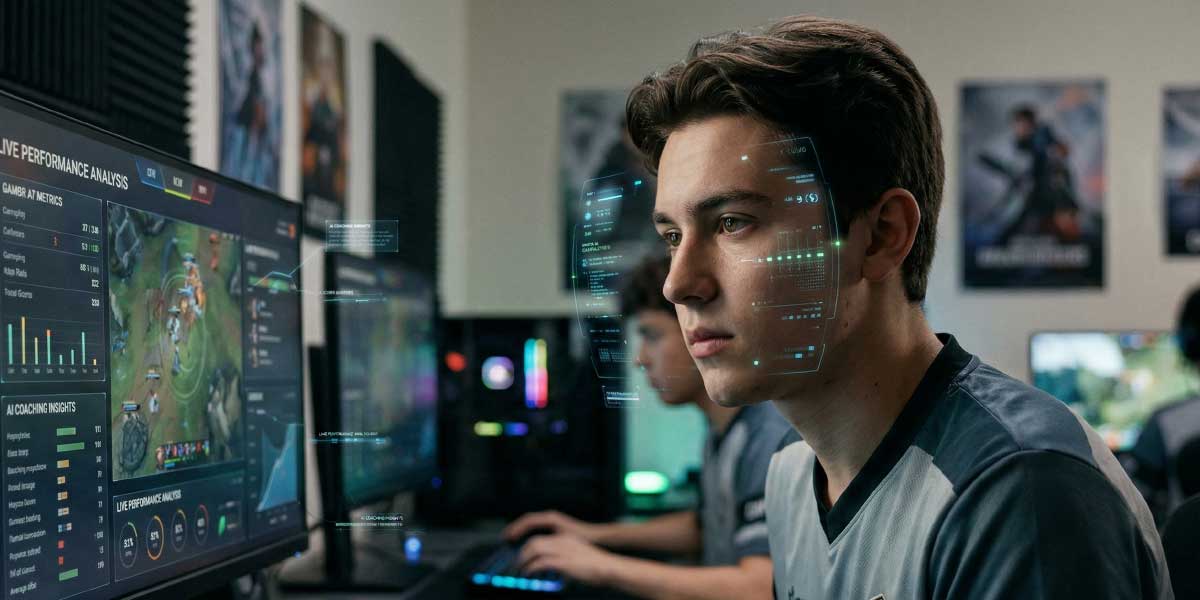
Somewhere in New Jersey, a high school sophomore is logging hours in Valorant, building a gameplay history she doesn’t yet know could help get her into college. Across the state, a community college coach is evaluating recruits with nothing more than highlight reels and gut instinct. These are the gaps that brought Shubber Ali, CEO of Omnic.AI, and David Bruno, Associate Dean at Camden County College, to a recent Esports Trade Association LinkedIn Live.
“There’s no more data-driven sport than ours,” Ali noted. “The irony being, we’re using so little of it.”
The Moneyball Moment
The reference point both speakers return to is traditional sports — not to romanticize it, but to borrow its roadmap. Analytics transformed how professional franchises recruit, coach, and compete, and Bruno sees esports at the same inflection point. What makes it uniquely positioned for this shift isn’t just enthusiasm — it’s architecture. Unlike basketball or baseball, where data must be manually captured or inferred, esports is played entirely on machines that record everything. Every decision, reaction, and pattern is already being logged.
The challenge, as Ali sees it, isn’t access. It’s volume. “There’s just not enough hours in the day,” he said, echoing what he hears most from coaches at every level. “There’s too much data and there’s only more being generated. AI gets you from the mountain of data to the insight hidden inside it.” That’s the core of what Omnic.AI has built — a platform now used by over 40 colleges and universities and more than 16,000 players across titles including Valorant, Fortnite, Rocket League, and Apex Legends.
From Blueprint to Playbook
Much of the conversation centered on the Garden State Sports Collegiate Combine, a New Jersey event modeled on the NFL combine — bringing student players together for evaluation by coaches and scouts. The honest takeaway was instructive. AI integration arrived too late to be fully embedded, leaving real gaps: no player decision-making pattern data, no team communication metrics, no direct pipeline into college recruiting. Bruno and Ali framed it not as a failure, but as a blueprint for what comes next.
The recruiting piece may be the most consequential. New Jersey alone has approximately 400 schools and 13,000 students competing in varsity-level esports, with 75% factoring a college’s esports program into their enrollment decisions. Yet recruiting still runs largely on highlight reels. What coaches actually need, Ali argues, is longitudinal data — three years of play showing trends, role tendencies, and consistency. “It’s no different than a transcript,” he said. “You want to know how they performed over time, not just their best game ever.”
The gap runs even deeper at the high school level, where many esports teams are sponsored by teachers who volunteered for the role rather than coaches with any competitive background. “The sponsor of the team isn’t actually a coach — they’re just the teacher who said yes,” Ali noted. For those students, AI doesn’t supplement coaching. It effectively becomes the coach.
A Classroom Opportunity
The solution, both speakers argue, starts early. A player who begins tracking their own gameplay data in high school arrives at recruiting with something far more valuable than a highlight reel — a longitudinal record of improvement, role specialization, and consistency that scouts can actually evaluate. Ali compared it directly to a student’s academic transcript: a full picture, not a curated one.
What sets this conversation apart is how deliberately both speakers connect analytics to academic opportunity. Bruno is already building curriculum pathways at Camden around esports analytics — internship pipelines and academic tracks weaving sports management into real data work. Three Camden students are currently interning at Omnic.AI, with skills that transfer well beyond esports into industries actively hiring for them.
The broadcast angle captures something important about where the industry is headed. Ali describes a near future where a single student, armed with AI-assisted analytics, can do what traditional sports networks staff entire teams to accomplish — surfacing real-time statistics and building player narratives on the fly. “It changes it from a transaction to a relationship,” he said. “You’re not just watching — you’re getting the full context of everything around it.”
For the schools that build the tools, the curriculum, and the pipelines now, the opportunity isn’t just preparing students for the esports industry. It’s defining what that industry becomes.